
How Long Should Commercial Rental Tents Last?
Commercial event tents are a long-term investment for event rental professionals, and understanding how long they should last is essential for maintaining safety, performance, and operational efficiency. This article provides a practical overview of tent lifespan, what factors influence it, and how proper handling and maintenance can extend usable life.
Average Lifespan of Commercial Rental Tents
The service life of a tent in an average rental environment typically falls within 5 to 15 years, depending on material quality, usage frequency, environmental exposure, and maintenance practices.
- High-quality vinyl tent fabric (PVC-coated & PVC-laminated polyester): 10–15 years
- Frame and structural components (aluminum/steel): 15–25+ years with proper care
It is important to distinguish between structural lifespan and fabric lifespan. While tent frames and poles may remain in service for decades, fabric components - tops, sidewalls, and accessories - are consumable elements that require periodic replacement.
Key Factors That Impact Tent Longevity
1. Material Quality
Commercial-grade PVC vinyl is engineered for durability, including resistance to ultraviolet (UV) radiation, abrasion, and moisture infiltration. Higher-quality coatings and base fabrics generally result in longer service intervals and more predictable performance over time.
2. Frequency of Use
Usage intensity is one of the most direct drivers of wear. Tents used frequently - especially in high-turnover rental operations - experience more handling cycles, transportation stress, and environmental exposure, all of which accelerate material fatigue.
3. Environmental Conditions
Environmental exposure plays a critical role in material degradation:
- UV radiation gradually breaks down coatings, causes plasticizer migration and reduces fabric strength
- Wind loading introduces repeated stress on seams, panels, and anchoring systems
- Moisture and humidity can lead to mildew growth and coating degradation if not properly managed
- Salt air (coastal regions) accelerates corrosion of steel components
- Cold and freezing temperatures reduce material flexibility. Vinyl becomes more rigid in low temperatures, which increases the likelihood of cracking during handling (e.g., unfolding, tensioning, or folding). Repeated freeze–thaw cycles can also stress seams and coatings, contributing to earlier wear if tents are not conditioned or handled appropriately.
4. Handling and Installation Practices
A significant portion of wear occurs during the installation and teardown of a tent. Common sources of damage include dragging fabric across abrasive surfaces, improper tensioning, and incorrect stacking or transport of frame components. Consistent handling protocols can substantially reduce avoidable damage. Additional handling and setup recommendations can be found in Aztec Tents' Product Resources (https://www.aztectent.com/resources/product).
5. Cleaning and Maintenance
Routine maintenance directly influences lifespan. Accumulated dirt, pollutants, and biological growth (e.g., mold or mildew) can degrade coatings and fibers over time. Proper cleaning, drying, and storage are essential to preserving material integrity. For standardized procedures, refer to the Aztec Tents Maintenance Guide.
Indicators of End-of-Life
Over time, tents will exhibit signs that indicate the need for repair or replacement:
- Tears, punctures, or seam separation
- Persistent staining or mildew that cannot be effectively removed
- Loss of fabric tension or dimensional stability
- Brittleness, cracking, or coating failure due to UV or environmental exposure
- Deformation or damage to structural components
Both performance and appearance should be evaluated, particularly in rental environments where consistency and presentation are important.
Extending Service Life Through Best Practices
Operational discipline can significantly extend the usable life of tent systems:
- Conduct inspections before and after each installation
- Clean materials using approved methods and solutions
- Ensure complete drying prior to storage
- Store in controlled environments when feasible
- Train staff on standardized handling and installation procedures
- Address minor damage early to prevent propagation
Solid vs. Clear Vinyl: Strength and Lifespan Considerations
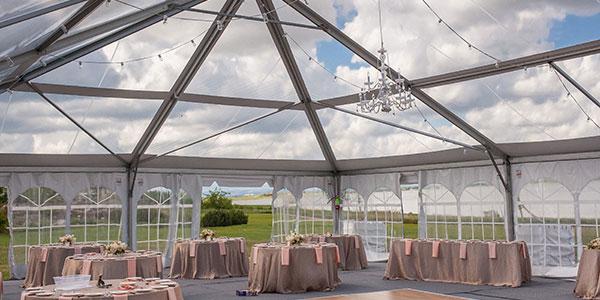
Not all vinyl fabrics perform the same in commercial rental environments. A key distinction exists between solid (opaque or translucent) vinyl and clear (transparent) vinyl, particularly in terms of strength, durability, and expected lifespan.
Solid vinyl fabrics used in commercial tents are typically laminated or coated composites, where a woven polyester base is encapsulated between protective vinyl layers. This construction provides:
- Higher tensile strength
- Greater resistance to abrasion and handling stress
- Improved performance under wind loading and environmental exposure
Clear vinyl, by comparison, does not include the same reinforcement structure, making it more susceptible to environmental and mechanical stress. Clear vinyl generally has lower tolerance to UV exposure, wind, temperature changes, and repeated handling compared to standard solid tent fabric. It is more prone to surface scratching, clouding, and loss of clarity over time. In colder conditions, it can become brittle and more susceptible to cracking during handling. Repeated movement, such as wind-induced flexing or frequent installation, can also contribute to material fatigue.
In contrast, solid vinyl fabrics are engineered to maintain structural integrity and appearance across a significantly higher number of installation cycles.
Impact on Lifespan
Because of these material differences:
- Solid vinyl is well-suited for long-term, high-frequency rental use and aligns with typical 10–15 year fabric lifespan expectations
- Clear vinyl often experiences accelerated wear, particularly in environments with high UV exposure or frequent handling.
As a result, clear vinyl is often treated as a specialty material within rental inventories, with more controlled usage and stricter handling requirements to maintain performance and appearance.
For more detailed procedures and guidelines, refer to the Aztec Tents Maintenance Guide, which outlines recommended cleaning methods, handling standards, and storage practices for commercial tent systems.
Conclusion
Commercial rental tents are engineered for repeated use, but their lifespan is ultimately determined by how they are used, handled, and maintained. Under typical conditions, fabric components provide 5–15 years of service, while structural elements often exceed that range. A clear understanding of environmental impacts - particularly UV exposure and cold-weather handling - combined with consistent operational practices, is essential for maximizing longevity and maintaining safe, reliable equipment.
For additional information please visit our website – www.aztectents.com
For cleaning and maintenance supplies go to – www.tentpros.com
For additional help, you can reach us here - https://www.aztectent.com/contact